Posts

What are Baleen Whales?

Image
  These beautiful photos of Baleen Whales are probably fascinating enough to be their own post. A thanks to all the sources that provide photos like these; they contribute greatly to the wonderous perception we have of the oceans. What are Baleen Whales? I've used this term multiple times throughout the Arctic subseries, such as in the Humpback and Bowhead Whale articles, but what does this really mean? Are Baleens a subspecies of whale? A type of whale? What are their main characteristics? It's important to know what all the terms mean when you're learning about new species, and really, anything in general. Don't bother with the 8,157 word Wikipedia page on Baleen Whales. Here's everything you need to know, served in the form of a short, yet substantial article with a generous side of sarcasm.   Here's a helpful diagram on the anatomy of a Baleen Whale. These features are characteristics of all Baleens; the most notable of which is the Baleen.  If one read th...

Whales vs Dolphins : What's the Difference?

Image
  In a physical showdown of Whale vs Dolphin, this picture shows that Whale beats Dolphin. But what about in intelligence? Emotional capacity?  Whales and Dolphins are both famous members of Cetacea, but what makes them different from one another? In a series of Whale vs Dolphin showdowns, you'll discover what exactly makes  Battle of Brute Force : In the right corner, we have... Team Whale, weighing in at a max of 180 tons. And in the left corner, we have Team Dolphin, weighing in at a max of...let's just say less than a ton.  One of the most obvious differences between whales and dolphins is size. Whales are generally bigger and heavier than dolphins, which have more stream-lined bodies.  Clearly, in a battle of brute force, whale beats dolphin. Let's look at the attributes of each group and find out why.  Whale Average Size: 10-110 feet long, up to 180 tons Body Shape: Thick, wide, round, surrounded by fat and blubber Dolphin Average Size: 5-35 feet long...

Cetacea

Image
  As seen here, Cetaceans are clearly some of the ocean's coolest creatures What makes a whale a whale? What about dolphins? Porpoises? Growing up, I was fascinated by these magical marine mammals, but I wasn't sure what exactly made them different from each other. Even though I knew they were different, somehow, I could tell that they all belong together in some way.  From Blue Whales to Belugas and River Dolphins to Vaquitas, all species of Whales, Dolphins, and Porpoises are Cetaceans.  Whales, Dolphins, and Porpoises all belong to the infraorder, Cetacea, because of several shared characteristics I'll be outlining below.  Marine Mammals All Cetaceans live fully aquatic lifestyles, which seems strange because these creatures are actually mammals. Being endothermic, or warm-blooded, is one of the aspects that separates Cetaceans from fish. Not all marine mammals are Cetaceans; animals like otters, walruses, and polar bears are also considered as marine ma...

World of Whales

  We're in the world of whales. I originally started the Oceans series as a general overview of all marine species, but now, it's expanded to so much more. This is probably not ideal as school has started which means that stress has been revived into my life. The Arctic series just came about when I couldn't' stop thinking about its mystery and beauty. We ended with the Humpback Whale  that can be found in the Arctic and almost all the oceans. This species is the connector to the next Oceans subseries... that I won't be announcing just yet. If there's anything that you've learned or should've learned from the Arctic subseries, it's that I love fantasy and mystery. Before we jump into the next oceanic region, I want to firmly establish the world of whales. And no, I couldn't come up with a better sounding title, but thank you World of Wars for being the inspiration for this article. The following posts will detail the facts I believe we should kno...

Fast Facts: Humpback Whale

Image
  The Humpback's scientific name, Megaptera, means "big-winged", a reference to the Humpback's long angel-like pectoral fins.  The Humpback Whale :   Delphinapterus leucas Description :  Humpback Whales can be distinguished from other whales by the humped shape of their backs and the long pectoral fins that can measure up to 15 ft long! Typically colored solid black, the Humpback Whale has a white underside and white pectoral fins. Another defining characteristic is the pleats alongside the Humpback's throat. Although Humpbacks are significantly larger than Belugas and Narwhals, they're only half the size of the largest whale in existence, around 50 feet long.  Habitat :  Found in oceans all over the world, the Humpback Whale typically spends time in the Northern and Southern pole regions during the summer where it spends several months feeding and hunting. In the winter months, the Humpback migrates to subtropical and tropical latitudes closer to the equat...

Fast Facts: Bowhead Whale

Image
  Yeah, the Bowhead Whale needs some time to get used to looking at. Yeah, that curved line is  actually its mouth. And yeah, its mouth does take up two-thirds of its head.  The Bowhead Whale : Balaena mysticetus Description : Bowhead whales have extremely large mouths and wide jaws that allow them to swallow an incredible amount of prey in one gulp. They actually have the largest mouth of nay animal! A distinctive white patch on their jaws stands out against their all-black bodies, and unlike many other whales, dolphins, and porpoises, Bowheads don't have a dorsal fin. However, they do have two small pectoral fins. Reaching lengths of up to 66 feet long, the Bowhead's skull and jaws make up about 30-40% of its entire body, which is covered in up to 20 inches of blubber, the thickest layer of blubber of any whale.  In addition, at full maturity, the Bowhead Whale weighs about 100 tons.  Habitat :  Although Bowheads do migrate to Canadian regions during the ...

The Narwhal: Unicorn of the Sea

Image
It's official. Unicorns exist. The Narwhal : Monodon monoceros Characteristics :   Around 18 feet in length and 3000 pounds in weight; the Narwhal's size is similar to a  Beluga's . With a long tusk protruding from the front of its head, two flippers, and black spots over white skin, the Narwhal is one of the world's most recognizable whales.                   Habitat :  Scattered through the Arctic Ocean and adjacent Northern Atlantic Ocean, Narwhals participate in seasonal migrations, moving from deep icy water in winter to shallow coastal waters in the summer.      Diet :  The Narwhal is a carnivore, and its diet is so specific that it can't survive in captivity. Cod, halibut, and redfish make up the majority of the Narwhal's diet while other marine creatures like shrimp and squid provide supplemental prey. Conservation : Near Threatened Why the Narwhal?  Why not the Beluga ?...

Fast Facts: Beluga Whale

Image
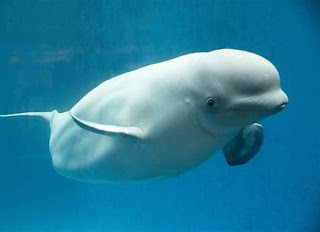
  The Beluga Whale's plump head makes it look cheerfully smiley all the time. I think this animal exudes cheer and playfulness. Even the name 'Beluga' sounds fun.  The Beluga Whale :   Delphinapterus leucas Description :  Beluga Whales are characterized by their white skin and unique rounded head shape. Calves are born with dark gray skin which lightens as they age; the maturity of a Beluga Whale can be determined when it's completely white. Unlike most whales, the Beluga Whale doesn't have a dorsal fin as indicated by the genus name. Instead, it has a dorsal ridge which allows it to maneuver and swim under the Arctic's sheets of ice. Beluga Whales can reach lengths of up to 18 feet and weigh up to 3500 pounds; it's one of the smallest whale species in the world.  Habitat :  Beluga Whale distribution ranges from the Arctic to the Subarctic. They live in the Arctic Ocean and its surrounding seas, including the Bering Sea, Hudson Bay, and Sea of Okh...

The Arctic Wolf: Moon Howling, Pack Hierarchy, and Other Myths

Image
  Following the  Polar Bear is none other than the Arctic Wolf, a fierce and majestic member of the Canidae  family.   The Arctic Wolf : Canis lupus arctos Characteristics : A medium-sized (around 3-6 feet in length) wolf characterized by its white fur Habitat : Arctic Wolves live in the Arctic regions of North America and Greenland as well as the Arctic Diet : Carnivores; Arctic Wolves prefer large prey such as Musk Oxen and Caribou. However, they will also prey on smaller mammals like lemmings, birds, and hares Conservation : Least Concern I love wolves. They embody all the adjectives I wanted to be growing up—fierce, vicious, beautiful, loyal, and  fast . I think I got at least three out of the five—mainly due to my competitiveness in playing tag every day for four years in elementary school—but only BuzzFeed has confirmed that the wolf could actually be my spirit animal.  Like the oceans, there's a mystery and magic to wolves. Magic, because they seem s...