Posts

Fast Facts: Humpback Whale

Image
  The Humpback's scientific name, Megaptera, means "big-winged", a reference to the Humpback's long angel-like pectoral fins.  The Humpback Whale :   Delphinapterus leucas Description :  Humpback Whales can be distinguished from other whales by the humped shape of their backs and the long pectoral fins that can measure up to 15 ft long! Typically colored solid black, the Humpback Whale has a white underside and white pectoral fins. Another defining characteristic is the pleats alongside the Humpback's throat. Although Humpbacks are significantly larger than Belugas and Narwhals, they're only half the size of the largest whale in existence, around 50 feet long.  Habitat :  Found in oceans all over the world, the Humpback Whale typically spends time in the Northern and Southern pole regions during the summer where it spends several months feeding and hunting. In the winter months, the Humpback migrates to subtropical and tropical latitudes closer to the equat...

Fast Facts: Bowhead Whale

Image
  Yeah, the Bowhead Whale needs some time to get used to looking at. Yeah, that curved line is  actually its mouth. And yeah, its mouth does take up two-thirds of its head.  The Bowhead Whale : Balaena mysticetus Description : Bowhead whales have extremely large mouths and wide jaws that allow them to swallow an incredible amount of prey in one gulp. They actually have the largest mouth of nay animal! A distinctive white patch on their jaws stands out against their all-black bodies, and unlike many other whales, dolphins, and porpoises, Bowheads don't have a dorsal fin. However, they do have two small pectoral fins. Reaching lengths of up to 66 feet long, the Bowhead's skull and jaws make up about 30-40% of its entire body, which is covered in up to 20 inches of blubber, the thickest layer of blubber of any whale.  In addition, at full maturity, the Bowhead Whale weighs about 100 tons.  Habitat :  Although Bowheads do migrate to Canadian regions during the ...

The Narwhal: Unicorn of the Sea

Image
It's official. Unicorns exist. The Narwhal : Monodon monoceros Characteristics :   Around 18 feet in length and 3000 pounds in weight; the Narwhal's size is similar to a  Beluga's . With a long tusk protruding from the front of its head, two flippers, and black spots over white skin, the Narwhal is one of the world's most recognizable whales.                   Habitat :  Scattered through the Arctic Ocean and adjacent Northern Atlantic Ocean, Narwhals participate in seasonal migrations, moving from deep icy water in winter to shallow coastal waters in the summer.      Diet :  The Narwhal is a carnivore, and its diet is so specific that it can't survive in captivity. Cod, halibut, and redfish make up the majority of the Narwhal's diet while other marine creatures like shrimp and squid provide supplemental prey. Conservation : Near Threatened Why the Narwhal?  Why not the Beluga ?...

Fast Facts: Beluga Whale

Image
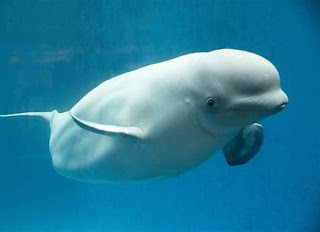
  The Beluga Whale's plump head makes it look cheerfully smiley all the time. I think this animal exudes cheer and playfulness. Even the name 'Beluga' sounds fun.  The Beluga Whale :   Delphinapterus leucas Description :  Beluga Whales are characterized by their white skin and unique rounded head shape. Calves are born with dark gray skin which lightens as they age; the maturity of a Beluga Whale can be determined when it's completely white. Unlike most whales, the Beluga Whale doesn't have a dorsal fin as indicated by the genus name. Instead, it has a dorsal ridge which allows it to maneuver and swim under the Arctic's sheets of ice. Beluga Whales can reach lengths of up to 18 feet and weigh up to 3500 pounds; it's one of the smallest whale species in the world.  Habitat :  Beluga Whale distribution ranges from the Arctic to the Subarctic. They live in the Arctic Ocean and its surrounding seas, including the Bering Sea, Hudson Bay, and Sea of Okh...

The Arctic Wolf: Moon Howling, Pack Hierarchy, and Other Myths

Image
  Following the  Polar Bear is none other than the Arctic Wolf, a fierce and majestic member of the Canidae  family.   The Arctic Wolf : Canis lupus arctos Characteristics : A medium-sized (around 3-6 feet in length) wolf characterized by its white fur Habitat : Arctic Wolves live in the Arctic regions of North America and Greenland as well as the Arctic Diet : Carnivores; Arctic Wolves prefer large prey such as Musk Oxen and Caribou. However, they will also prey on smaller mammals like lemmings, birds, and hares Conservation : Least Concern I love wolves. They embody all the adjectives I wanted to be growing up—fierce, vicious, beautiful, loyal, and  fast . I think I got at least three out of the five—mainly due to my competitiveness in playing tag every day for four years in elementary school—but only BuzzFeed has confirmed that the wolf could actually be my spirit animal.  Like the oceans, there's a mystery and magic to wolves. Magic, because they seem s...

Fast Facts: Polar Bear

Image
The word Arctic is derived by the Greek word meaning 'bear'. This is how you can remember that Polar Bears are found in the Arctic and not that other icy region on the other side of the Earth.  The Polar Bear :  Ursus maritimus Description :  The Polar Bear is the largest surviving species of bear in the world. Males typically grow to around 1500 pounds at adulthood and females typically reach 500 pounds. Polar Bears are distinguishable from other bears because of the bright white appearance of their fur. However, Polar Bears also differ from other bear species because of their longer skulls and noses and smaller ears and tails. These elongated features make the Polar Bear a powerful swimmer. A Polar Bear also has smaller, stockier claws that are better disposed to grip ice and large prey.  Habitat :  Polar Bears live in the coastlines and sea ice of the Arctic. The Arctic ice is the ideal place for Polar Bears to hunt for seals. They typically spend 5-6 mo...

Fast Facts: Ermine

Image
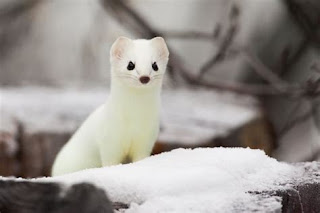
  When I look up 'Ermine', the first results that pop up are ermine furs and coats. This is giving me flashbacks of my Amazon post The Ermine :  Mustela erminea Description :  Also known as a Stoat, the Ermine is a kind of weasel and is part of the  Mustelidae family . Measuring around 7-12 inches long, the Ermine's physical characteristics include a long tail, dark eyes, a small triangular nose, an elongated neck, and round ears. In the warmer months of summer, the Ermine is brown with a white belly. In the winter, the Ermine blends into its new surroundings by utilizing a white fur coat. In all seasons, the Ermine's tail is tipped with black. Habitat :  Ermines live in many different areas, but all of them generally have cold climates. Ermines live in habitats ranging from mountains to moors to woodlands. Many of these areas have crevices and nooks where the Ermines can establish dens. Ermine distribution is as varied as their habitats; the...

Fast Facts: Snowy Owl

Image
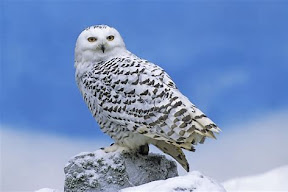
  Presenting the Snowy Owl. AKA my childhood favorite owl. AKA the subject of my first science presentation. AKA HEDWIG The Snowy Owl : Bubo scandiacus Description : Being one of the most well-known owls on the planet, the Snowy Owl 's distinct white feathers patterned with black and brown make it stand out even in the snow-covered tundra. Males tend to have whiter overall while females have more pattering on their feathers. All Snowy Owls have especially thick feathers to protect them against the below freezing temperatures of the Arctic. With a wingspan of five feet and weight of 4 pounds, this adaptation also makes the Snowy Owl one of the largest and heaviest owls in the world.  Habitat : Preferring habitats with elevation, such as outcrops and knolls, Snowy Owls are mostly found in open tundra and coastal habitats. In contrast, their habitats also often include flat and even areas where Snowy Owl parents will set up breeding sites for their young. In many cases, a tidal f...

Fast Facts: Arctic Fox

Image
  At first glance, Arctic Foxes are fluffy and adorable. But under all that fur is a elegant and fierce predator that braves the Arctic's temperatures of -50  ° F  to 50  ° F every day The Arctic Fox : Vulpes lagopus Description : Native to the Arctic regions, the Arctic Fox is a thick-coated mammal around 30-40 inches long; the size of a dog. Distinguishable by its white fluffy coat, this animal is either white/blue (depending on the morph) in the winter and turns into varying shades of brown in the summer. The Arctic Fox is also characterized by its upturned snout, triangular ears, flattened skull, and long tail which reaches about a foot in length.  Habitat : Equipped with thick fur to keep them warm, Arctic Foxes are found in the Arctic tundra and pack ice where the ground is permanently frozen with little vegetation available. They can also be found along the edges of forests in Northern parts of Europe, Canada, and Alaska.  Diet : Arctic Foxes ar...

Simply Something New

  Don't get too excited, this "something new" isn't anything ground-breaking.  I generally don't like creating posts unrelated to an ecosystem or species, but once in a while, a non-wildlife related post is a nice break in between information dense articles and fact sheets. And I'm not going to lie, these kinds of posts are easy points to add to my post total, a number that's been growing steadily over the last couple years.  In this Arctic Ocean series, I'm going to try a new kind of set-up. Midway through the Amazon Rainforest series, I introduced a new kind of post, Fast Facts! (named after my fave scioly event ever). I was able to highlight way more species with Fast Facts! (yes, say it with the exclamation point), and while I still plan on writing up these Fast Facts! posts, I want to shift my focus to more traditional articles again.  Contrary to the Amazon series where my goal was to cover as many species as possible, the Arctic Ocean series wil...

Kingdom of the Midnight Sun: The Arctic Ocean

Image
  'Arctic' means "of the north" and is derived from the Greek word "arktos" which means "bear" There's something magical about the Arctic Ocean. It's beautiful yet unassuming, crowning the top of the world with its 5.43 million sq miles of pure ice shattered and scattered across its blue like diamonds. Christened as the Land of the Midnight Sun, this kingdom never sees the sun set. And with all that light, it's not hard to believe that there's something fantastical waiting out there. And no, I'm not talking about that conspiracy theory claiming that the wealthiest people are hiding out in "second earth" under the guise of the Arctic.   The Arctic feels like a window to another realm, pure and untamed, ethereal and otherworldly. Perhaps this is because the Arctic is practically untouched by outsiders. People talk about the former glory places like the Great Barrier Reef and the Amazon Rainforest once had and how these...