Posts

Jellyfish of the Great Barrier Reef

Image
  This post only exists because of a critical error I made in the last post. Cheers to fact checking. Ok, I know I said that there would be two Blanket Octopus posts, but I changed my mind (see here ). All the info is now in one post. Anyways, while I was reading back on the Blanket Octopus, I realized that I said the Portuguese Man-of-War was a jellyfish.  Which is wrong. It's actually a siphonophore.  Which looks exactly like a jellyfish.  Which is why I wanted to create this post. There are over 200 different species of jellyfish in the world, and around half of those species have been found in the Great Barrier Reef. These beautiful, ethereal creatures have always seemed to come from a different world to me. Glowing orbs of light, floating serenely at bottomless depths—like the ocean's angels. Except these angles are quite dangerous and quite capable of killing. Here, I'm going to spotlight some of what I think are the Great Barrier Reef's most fascinating specie...

The Four Species of Blanket Octopus

Image
  The ocean is this queen's runway, and we're just lucky to witness her glide down it.    Blanket Octopus :   Tremoctopus  Finally we find an animal where DNA determines females get the flashy traits and not  the males. When it comes to survival, it happens to be that males typically have brighter feathers or a red balloon under his neck or some other supposedly attractive trait to guarantee his flashy traits get passed down. I mean, even humans make the list. Why is it that every single guy I know has better eyelashes than me? Blanket Octopuses are found in the coral reefs of the Pacific and Atlantic oceans' sub-tropical and tropical waters.  There are four kinds of Blanket  Octopuses, which I'll cover in this post, and in all four species, it's the females who have the sunset-colored, billowing capes that give Blanket Octopuses their name.  What's even more shocking than the fact that the ladies finally get to stand out from the crowd is th...

Fast Facts: Maori Wrasse

Image
Known by many names, including the Humphead Wrasse and Napolean Wrasse, this fish is known as a king of the coral reefs.    The Maori Wrasse :   Cheilinus undulatus Description : Reaching up to 2 meters in length and 180 kg in weight, t he Maori Wrasse is the largest species in the Wrasse family. They are easily distinguishable by the hump on their foreheads, which become more prominent with age, as well as their puffy lips. Based on the age and gender of a Maori Wrasse, its color patterns vary from red and orange to yellow and green and blues.  Habitat :  Found in the Indo-Pacific's tropical waters, the Maori Wrasse tends to cling to the temperate-coastal habitats of Australia. Maori Wrasse can inhabit all types of reefs, from rocky reefs by the shore to off-shore reefs reaching depths of 60 meters.  Diet : Maori Wrasse are carnivorous creatures that feed primarily on crustaceans, mollusks, and other benthic creatures. They may even eat smaller fish! Maori...

The 21st Century's New World: The Pacific Ocean

Image
  Here is a place where life collides into the unknown  Let's be honest, you only had like two oceans to guess from in the last post. It was not that hard to guess where the subject was going.  After an admittedly few but efficient five minutes on learning about this blog's next stop, I've decided that one of the most fascinating and defining traits of the Pacific Ocean is its sheer size.  As our largest and deepest ocean, the Pacific Ocean's 63,800,000 sq miles of surface blue lays over an average depth of 13,000 feet. That's about 12 Eiffel Towers speared under the surface pointing to some lightless, yet not lifeless, land we know very little about.  What does this all mean? Well, one is that I'm too lazy to find the calculated volume of the Pacific Ocean using the stats *1 above. Two is far more thought-provoking. The mystery volume I didn't calculate from above is insanely large. Considering that only around 5% of the oceans have been explored and that ...

A New Chapter

Image
  Sapphire blues and turquoise hues... guess who. This next stop is a surprise; any guesses that come to you? Sapphire blues and turquoise hues diffuse into the sighing sea that surrounds you. A symphony of color and life, you breathe out in awe and remember that only bubbles and the blue can judge you down here. Here—where the flora spiral into skies and sculpt art out of dust and air *1 . Here—where the fauna is the darting dancers whose seemingly silent steps and streaks stream together into a song only those belonging to this deep can hear.  Here, the sea doesn't just reflect starlight, it can be seen from the stars—in the devoid abyss of space that mirrors the depths of some other deep.  But not this one.  Here, the sea reaches down a shallow 200 feet. But despite the lack of depth, this place stretches over 133,000 sq miles and contains over 9000 species, making it the largest coral reef system in the world.  Welcome to an explosion of color, life, and bea...

Celebrating Earth Day: 10 of the Most Magical Places on Earth

Image
  Earth Day 2023!  Let's celebrate Earth Day 2023 by highlighting the beauty and wonder that our earth has to offer.  1.  Caño Cristales  - a river in Colombia that is also known as the River of Five Colors. This river is has extremely clear water as a result of a lack of nutrients (and fish), but from June to November, an endemic aquatic plant, perfect water levels, and sunlight create the vibrant colors seen below 2. The Great Barrier Reef  - the largest coral reef on world located on the Northeastern coast of Australia. There are over known 9000 species that inhabit the Great Barrier Reef.  3.    The Northern Lights  - also known as Aurora Borealis, this phenomenon can be seen best in the Northern Hemisphere. When solar wind impacts the atmosphere, these displays of lights are created.  4.    Victoria Falls  - the world's largest waterfall. This waterfall is home to a multitude of species and is located on the...

10 Environmental Statistics Everyone Should Know

Image
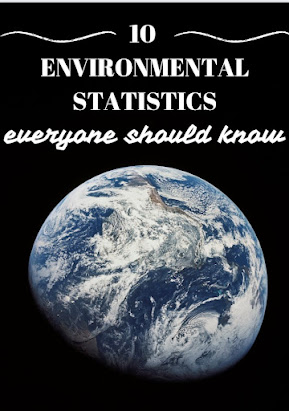
Sound smart to others using your arsenal of statistics courtesy of this post.  This post may seem to contradict the message of my last post. Yes, these statistics may seem scary, but naivety may be even more so. And without further ado, you may begin - begin on your journey of understanding and knowledge with these short, succinct stats.  Here are 10 statistics about the earth I think we should all know. 1. 6.96 millions of hectares of tree cover have been lost from wildfires alone 2. Improper disposal of cigarettes are the cause of 8-10% of the US's wildfires 3. Over 2 billion pounds of toxic waste were generated this year through mining alone 4. 1.3 billion tons  of food is wasted annually, enough to feed a third of the world's population 5. The earth's CO2 ppm is currently at 420 6. Wildlife populations have experiences an average loss of 68%  since 1950 7.   Around 350 million tons  of plastic waste were generated last year 8. Every hour, ar...

10 Simple Ways to Be More Eco-Friendly

Image
  Being more eco-friendly doesn't have to mean going vegan or swearing off plastics... Especially during this time of the year, it seems like everyone is telling us to be more eco-friendly. This seems like a huge task, and oftentimes, being 'more eco-friendly' sounds like it requires a lifestyle change or other drastic action to succeed, which isn't true. Although the statistics regarding the earth's environmental problems are huge, our steps to be more eco-friendly doesn't have to be. Here are 10 simple ways to treat the earth a little better than before. Incorporating these simple changes in your life may go a long way in changing your mindset and even the world.  1. Turn your lights off! Make sure you turn those light switches off after leaving a room and especially when you leave you house. Not only does this save energy, but turning off your light can also save you money in the long run. 2.   Use LEDS! Speaking of light, LEDS use over 75% less energy than r...

Earth Month 2023!!!

Image
  Earth Month 2023 is here... April is Earth Month. A period to bring awareness to our planet. An opportunity to consider our own self-awareness for not only our actions but our abilities to make a change.  Change doesn't just mean reaching net zero emissions or planting a thousand trees; actually, planting trees may not be as helpful as we think but that's a different story. Earth Month allows us to make small changes that better ourselves and the planet by providing educational resources and motivation.  We're constantly being told to be more eco-friendly or that the Earth is being destroyed. This annually set time of April focuses the narrative. Like all other federal holidays, Earth Day unites everyone and highlights the good. As we countdown to April 22nd, Earth Day, we can consider how far we've come as well as how far we have to go.  And on the way, we can learn how to keep going through the multitude of resources made available during this month. Every w...

Marine Algae: Seaweed Species, Snacks, and Other Stories

Image
  Seaweed is both healthy and delicious, for the ocean and us. And yeah...keep reading for more info  *1 My uncle used to send over lil care packages of specialty candies and foods, and one of my favorites were the spicy seaweed snacks—butterfly wing-thin, crisp, neat rectangles. Seaweed has long been considered a superfood in my household as it contains fiber, antioxidants, iodine, and a smattering of other minerals and vitamins. Besides the spicy snacks, seaweed can also be served as a spicy salad which more closely resembles the picture above plus some red pepper flakes. A healthy eating tip just for you; look at the things you can learn from my blog! *2 These snacks are typically made out of nori, a type of seaweed that's been around in Japan for centuries. There are over tens of thousands of seaweed species; estimates range from 30,000 to 100,000. This fact is probably more believable considering that seaweed isn't really a plant; it's a macroalgae.  But what ex...

Apples to Oranges to Lemon Sharks: An Essay on Comparison

Image
  Here's a riddle for you: What do 3 apples, 2 oranges, 1/2 a lemon, and a drizzle of honey get you? *1 *2 Now, answer this: what do apples and oranges have to do with Lemon Sharks (besides the fruit names)? Yeah, there aren't any footnotes for this; you're gonna have to actually read this post for the answer.  The Lemon Shark :  Canis lupus arctos Characteristics :  Lemon Sharks range from lengths of 8-10 feet and weights of 400-550 pounds. They're distinguishable by their olive yellow skin and lighter yellow underbelly which gives this shark its name. Two triangular dorsal fins, one by the pectoral fins and one by the anal fin, also serve as identifiers. Additionally, Lemon Sharks have flatter heads and shorter snouts compared to other shark species. Habitat :  Lemon Sharks are often found in shallow coastal waters near the Pacific and Atlantic coasts no deeper than 260 feet in depth.  Diet : Carnivores; more info below Conservation : Near Threatened The ...